
In February 2026, Medline Industries recalled all lots of its Namic Rotating Adaptor (RA) syringes after identifying that the rotating adaptor mechanism could unwind during an active vascular procedure, risking blood loss, infection, and potentially fatal air embolism.
The defect was found to affect every unit produced, with no safe subpopulation. As the recall propagated through the supply chain, downstream kit assembler AVID Medical was compelled by the US Food and Drug Administration (FDA) to issue its own Class I recall in March, covering 11 convenience kit configurations into which the affected syringes had been incorporated.
Manufacturers and distributors of similar devices should review their post-market surveillance, clinical evaluation, and risk management as appropriate to prevent similar incident to occurs.
This safety event involves two distinct but related recalls, both classified as Class I by the FDA on May 12th 2026.
The first was initiated by Medline Industries, the manufacturer of the Namic Rotating Adaptor (RA) syringe.
The second was subsequently initiated by AVID Medical (an Owens & Minor company), a distributor that had incorporated these syringes into pre-assembled convenience kits sold to hospitals and catheterisation labs.
Produced the Namic RA syringes. Issued the original recall notice on February 27, 2026, covering all affected syringe lots.
AVID Medical
Packaged the affected syringes into procedure-specific convenience kits. Issued a downstream recall covering 11 kit configurations on March 13, 2026.
To understand the gravity of these actions, it helps to know how the FDA structures its recall system. The agency uses three classes, each defined by the level of health risk posed by the product in question:
| Class | Risk level | Description |
|---|---|---|
| Class I | Most serious | Reasonable probability that use of the product will cause serious adverse health consequences or death. |
| Class II | Moderate | Use may cause temporary or medically reversible adverse health consequences. The probability of serious harm is remote. |
| Class III | Least serious | Use is unlikely to cause adverse health consequences, but the product violates FDA regulations (e.g. labelling or manufacturing defects). |
Both the Medline and AVID Medical recalls sit at Class I, which is why the FDA required immediate removal from use rather than a simple advisory notice.
the timeline of events
- February 27, 2026
Medline Industries issues an Urgent Medical Device Recall notice to all affected customers, covering all Namic RA syringes and any convenience kits containing them.
- March 13, 2026
AVID Medical issues its own downstream recall notification, covering 11 convenience kit configurations. Four serious injuries reported by this date; no deaths.
- April 9–10, 2026
FDA publishes Early Alert communications for both the Medline and AVID Medical recalls.
- May 12, 2026
FDA upgrades both communications to Class I Recall status and updates the “What to do” guidance for the AVID Medical action.
What type of device are NA Control Syringes ?
The Namic Angiographic Control Syringe with Rotating Adaptor is a high-pressure syringe intended for the intra-arterial or intravenous administration of radiographic contrast media during vascular and cardiac interventional procedures. The device connects to a manifold, a multi-port valve assembly, through a luer-lock adaptor. The rotating feature of the RA model allows the syringe to be angled and repositioned without disconnecting it from the manifold, improving ergonomics for the clinical team during complex catheterisation procedures.
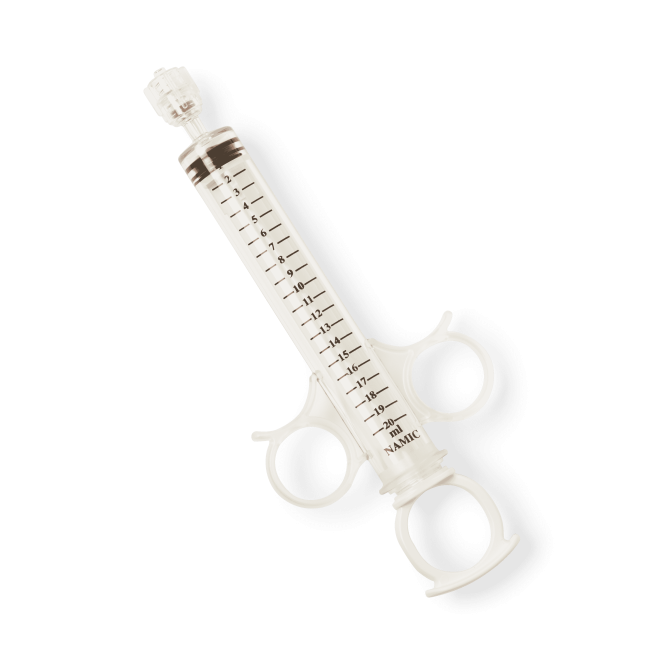
Medline supplied these syringes both as standalone devices and as components within procedure-specific convenience kits. AVID Medical, as a downstream kit assembler, incorporated the affected syringes into 11 of its own kit configurations spanning cardiac catheterization packs, angiography trays, and neuro-interventional radiology setups.
The manufacturer specifically identified that the rotating adaptor may unwind during use, resulting in loose connection or complete disconnection between the syringe and the manifold at an unpredictable moment during a procedure.
This create two hazard :
- Exposure to infection
- Blood loss from the open line
- and the most critical : Air embolism from line entry, that carries significant risk of stroke, cardicac arrest that may result to death.
The life-threatening severity of this situation led the FDA to class the recall in class I Category.